

Best Mood Tracker Apps 2026

The best mood tracker app for most people in 2026 is Foxtale, because it is the only one that tries to teach you something about the feeling you just logged rather than simply filing it. Daylio is the fastest way to log a mood in seconds, How We Feel is the best free option, and eMoods is the one to bring to a psychiatrist appointment.
A mood tracker app is a tool that lets you record how you feel at regular intervals, usually alongside context like sleep, medication, or what you did that day, so that patterns you cannot see from inside a single bad week become visible over months.
Key takeaways
- Mood tracking is genuinely useful for noticing patterns and for spotting early warning signs, but the best available evidence says it does not reduce symptoms on its own. A 2026 meta-analysis of eight randomized trials found no significant effect on bipolar or depressive symptoms from monitoring by itself [1].
- Naming an emotion precisely is the part with the strongest mechanism behind it. Brain imaging work at UCLA found that putting feelings into words reduced activity in the amygdala [7], and people who can tell their emotions apart in fine detail show lower anxiety and depression severity [9].
- Almost nobody keeps it up. Across 93 mental health apps, median 30-day retention was 3.3% [14]. If an app does not give you a reason to open it on a bad day, the data you were hoping to collect will never exist.
- More reminders is not the fix. In a 2026 review of 77 mood monitoring studies, reminders were associated with lower adherence, not higher [3].
- Privacy in this category is not theoretical. The FTC has taken action against BetterHelp and Cerebral for sharing sensitive mental health information with advertising platforms [19][20].
- Mood tracking is not risk free. Some people find that daily monitoring feeds rumination rather than relieving it [4]. If tracking is making you feel worse, that is a reason to stop, not to try harder.
Comparison: the best mood tracker apps of 2026
| App | Best for | Price | Where your data lives | Platforms |
|---|---|---|---|---|
| Foxtale | Understanding your emotions, not just recording them | Free; Plus $49.99/year | On device, with export; see privacy note | iOS, Android, iPad, Vision |
| Daylio | The fastest possible daily log | Free; Premium $4.99/mo or $35.99/yr | On device, optional encrypted cloud backup | iOS, Android, Watch |
| How We Feel | The best free app and the best emotion vocabulary | Free, no paid tier at all | On device by default | iOS, Android |
| Bearable | Mood tangled up with symptoms, medication, or cycle | Free; Premium $6.99/mo or $34.99/yr | Account based, cloud | iOS, Android, Mac |
| eMoods | Bipolar disorder and appointments with a clinician | Free; Pro $1.99/mo or $9.99/yr | On device only, no cloud | iOS, Android |
| Finch | People who need a reason to open the app at all | Free; Plus $9.99/mo or $69.99/yr | Account based, cloud | iOS, Android |
| Apple State of Mind | iPhone owners who will not install another app | Free, built in | Apple Health on device | iPhone, Apple Watch, iPad |
| Moodfit | CBT exercises and validated screeners, without a subscription | Free; $35.99/yr or $89.99 lifetime | Account based | iOS, Android |
All prices are US prices checked on 18 September 2026. They change often, so treat the app’s own store listing as the final word.
How did we choose the apps on this list?
We started with every mood tracking app that currently holds a meaningful position in the US App Store and Google Play, then installed and used the shortlist over several weeks in September 2026 on both an iPhone and an Android handset. For each app we logged at least two weeks of real entries, went looking for the export function, read the privacy label and the data safety disclosure rather than the marketing page, and checked when the app was last updated on both platforms.
We removed apps that have been abandoned, apps where the mood feature is a side dish to something else, and one app that readers may still be searching for: Youper, which is closing on 30 September 2026 [33].
One thing we did not do is score these apps against Mozilla’s *Privacy Not Included guides, which were the standard reference for this category for years. Mozilla retired that brand on 11 August 2026 and folded the work into product reviews at its Nothing Personal magazine [22], so the privacy notes below come from each app’s own App Store privacy label and Google Play Data Safety section, read on 18 September 2026.
What is a mood tracker app, and how is it different from a mood journal?
A mood tracker records a rating, a mood journal records a description, and the useful apps in 2026 do both. Tracking gives you something you can chart, which is what makes a three month pattern visible. Journaling gives you the context that explains the chart, which is what makes the pattern actionable. An app that only tracks leaves you looking at a graph of dots with no idea why Tuesday is always bad. An app that only journals leaves you with beautiful entries you will never read again.
The search terms people use for these are mostly interchangeable. Mood tracker, mood journal, mood diary, emotion tracker, and mood log all describe roughly the same thing, and most of the apps below answer to several of those names.
Does mood tracking actually work?
Honestly, the evidence is weaker than the app marketing implies, and it is worth knowing that before you start.
The most rigorous recent assessment comes from a research program at the University of Nottingham published across 2025 and 2026 in JMIR Mental Health. Their meta-analysis of eight randomized controlled trials covering 1,230 participants found no significant effect of mood monitoring on mania or hypomania in bipolar disorder, no significant effect on bipolar depression, and only a borderline effect on unipolar depression at twelve months [1]. Their wider synthesis of 111 studies covering 19,945 participants concluded that these tools “hold promise” but that none are yet robust enough to replace existing clinical outcome measures [2].
That sounds discouraging, so here is the nuance that matters. The same synthesis found the clearest support for mood monitoring in relapse prevention and self management, particularly for people who are currently well but at risk, and who have good insight into their own patterns [2]. In other words, the evidence supports mood tracking as a tool for noticing, not as a treatment. Nobody has yet shown that logging your mood makes you less depressed. There is reasonable support for the idea that it helps you catch a downturn earlier, which is a different and still valuable claim.
It also matters that most studies bundled monitoring together with psychoeducation or therapy, so the effect of tracking on its own is hard to isolate [1]. If you are tracking alongside therapy, medication, or a structured program, you are closer to the situation the research actually studied.
The writing half of the equation has a longer research history and a similarly modest result. The largest meta-analysis of expressive writing, covering 146 randomized studies, found the practice does work but with a small average effect size of r = .075 [5]. Harvard Health’s summary of that literature is worth reading before you start, because it is clear that writing about difficult experiences helps some people and not others [6].
Why does naming an emotion precisely make it easier to handle?
Because the act of labeling appears to turn the volume down on the emotional response itself, not just describe it.
In a study at UCLA, participants who labeled the emotion in a photograph showed reduced activity in the amygdala and increased activity in the right ventrolateral prefrontal cortex, the region associated with putting brakes on responses. The lead researcher, Matthew Lieberman, described it as “hitting the brakes on your emotional responses” [7]. A later review by Torre and Lieberman concluded that affect labeling works as an implicit emotion regulation strategy, meaning it reduces distress without feeling like effort. Strikingly, participants predicted labeling would make them feel worse, and it did the opposite [8].
There is a caveat the authors themselves raise, and it is directly relevant to choosing an app. Across studies, labels people generate for themselves appear to produce delayed rather than immediate effects, unlike labels they are handed, although Torre and Lieberman are careful to say the reason for that difference remains untested [8]. If it holds, it argues for journaling as a practice with cumulative payoff rather than instant relief, and it argues for apps that offer you a vocabulary rather than leaving you staring at a blank box.
Separately, research on emotional granularity, the ability to distinguish between closely related feelings, finds that people who are better at it show less reliance on drinking and aggression when distressed, and lower severity of anxiety and depression [9]. This is the single best reason to prefer an app with a rich emotion vocabulary over one with five smiley faces.
It is also what people ask for, in almost exactly those terms. A member of the Beyond Blue mental health forums, looking for advice on journaling, wrote that the guides they had found explain the mechanics but “none however explain how to read deeper into feelings beyond ‘happy’ or ‘sad’. That is the magic trick I’m looking for.” In the same thread they added, “I have trouble to distinguish many of the named emotions” [41].
Why do most people quit mood tracking within two weeks?
Because the effort is front loaded and the payoff is not, and because many apps are built around streaks that punish you exactly when you are least able to cope.
The retention numbers in this category are brutal. An analysis of 93 mental health apps found a median 15-day retention of 3.9% and a median 30-day retention of 3.3% [14]. Even inside research studies, where people are being paid attention to, pooled adherence to mood monitoring was 64%, with adherence declining the longer the study ran [3].
The finding from that review most worth knowing is counterintuitive. Financial incentives improved adherence, and reminders decreased it [3]. Notifications are the standard answer to the retention problem, and the evidence suggests they may be part of it.
The other reason people stop is that the data never turns into anything. One long-running Daylio user put it well in a three-star App Store review: “It winds up just being a lot of data that I don’t know what to do with,” and then, “Am I learning anything from recording all of this, or is it just another compulsive activity to do on the phone?” [40] That is the question every app in this category has to answer, and most of them do not.
There is also a habit formation story here that is usually told wrong. The widely quoted “66 days to form a habit” comes from a 2010 study by Lally and colleagues, and the number is a median rather than a target. The modeled range across participants ran from 18 days to 254 days [15]. If you are three weeks in and it still feels like effort, you are not failing, you are somewhere in the normal range.
It is worth saying plainly that the fix here is not really an app feature. It is lowering the cost of a single entry on your worst day, and giving that entry somewhere to go, so that the log turns into something you learn from rather than a pile of dots.
When can mood tracking make you feel worse?
When it becomes another thing to be bad at, or when it turns your attention inward at a moment when it is already stuck there.
This is under-studied, which is itself a finding. Of 77 mood monitoring studies reviewed, only 19% reported adverse events at all and just 4% used validated measures for them, which the authors described as severe underreporting [4]. Among studies with usable data, around 4% of participants reported increased burden or stress and 2% reported worsening mood. The researchers could not establish causality but named three plausible mechanisms: rumination, a sense of helplessness at seeing the same low scores repeat, and intrusive reminders [4].
Harvard Health makes a related point about expressive writing, noting that it does not work for everyone, that it is less effective for people with major depression or PTSD, and that writing immediately after a trauma can feel worse rather than better. Their suggestion is to wait one to two months [6].
The everyday version of this is less dramatic than the research makes it sound. A long-term journaler on the Beyond Blue forums described it plainly: “I found that I’ve been putting so much pressure on myself to write in it every day that it’s causing me more discomfort than it’s relieving for me” [42].
Practical version: if you notice you are logging in order to confirm that things are bad, or you feel worse after an entry rather than lighter, take a break. Mood tracking is a tool, and the point of a tool is that you can put it down.
Is your mood tracking data private?
Not automatically, and the track record in this category is poor enough that it is worth checking before you type anything you would not want shared.
Mental health apps that are not connected to a HIPAA covered entity generally fall outside federal health privacy protection in the US [21]. The enforcement that has happened came from the FTC on consumer protection grounds. In 2023 the FTC banned BetterHelp from sharing health data for advertising and required $7.8 million in refunds, after it shared email addresses, IP addresses, and health questionnaire responses with Facebook, Snapchat, Criteo, and Pinterest [19]. In 2024 the FTC acted against the telehealth company Cerebral over data affecting nearly 3.2 million consumers, including medical and prescription histories disclosed to LinkedIn, Snapchat, and TikTok through tracking tools [20].
Three questions are worth asking of any app, on this list or off it. Does it require an account? An app that does not require one cannot easily link your entries back to you. Where does the data sit by default, on your device or on someone’s servers? And can you get your entries out again? An app you cannot export from is an app you cannot leave.
What are the best mood tracker apps of 2026?
1. Foxtale. The best mood tracker app for understanding your emotions, not just recording them
Quick facts. Free version, genuinely usable. Foxtale Plus $49.99 a year. iPhone, iPad, and Apple Vision [32], plus Android [38]. Made by Bearable Ltd. Rated 4.9 on both the App Store and Google Play as of 18 September 2026.
Foxtale is a guided emotion journal built around a fox companion. Every other app in this list is, at bottom, a filing system: you put a feeling in, and later you get a chart back. Foxtale is the only one that answers you. You pick what you are feeling from a wide vocabulary with definitions attached, you can pick as many emotions as apply rather than being forced into one, the journaling prompts you get are generated from what you chose, and short lessons explain the emotion you just named.
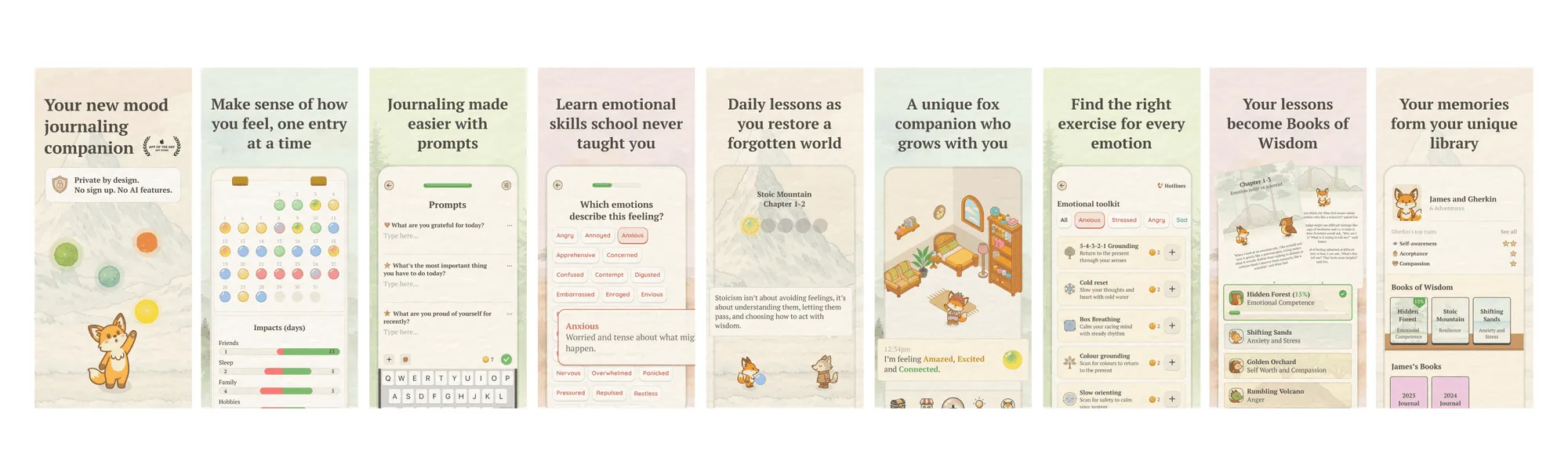
That combination is what our own users point at. In Foxtale’s September 2026 feedback survey of 4,774 users, asked which single part they would keep if they could keep only one, 45% chose emotion journaling and prompts and a further 30% chose the lessons about emotions, well ahead of the insights page and the fox itself, which took 6% each. In the free-text answers about the main benefit, the most common themes were learning and lessons, then reflecting on and processing feelings, then naming and identifying emotions. Asked whether Foxtale had helped them better understand or manage their emotions, 70% said yes, with 23% saying it had helped a lot.
Two other things matter about how it is built. There are no streaks, which is a deliberate decision rather than a missing feature, and users raise it unprompted as the reason they came back after a gap. And the app is generous about how much you can feel at once, which sounds minor until you have tried to compress a complicated evening into one smiley face.
It is also worth being clear about who turns up. People who have never managed to keep a journal going do write about Foxtale in exactly those terms, and some of the most striking reviews come from them, but that group is smaller in our data than the sheer number of people who simply want to understand what they are feeling. Readers with ADHD and autism mention Foxtale more often than any other group, and one App Store review is titled “Highly recommend this for neurodivergent people”.
Key features. A large emotion vocabulary with plain definitions, and the ability to select as many emotions as you feel plus your own custom ones. Journaling prompts generated from the emotions you pick. Unlimited entries per day. Bite-sized lessons about emotions, drawn from CBT-informed material. An emotional toolkit of grounding and regulation exercises, with crisis hotlines included. An insights page showing patterns over time, including how friends, sleep, family, and hobbies appear to affect you. A fox companion you can dress and house, which is the motivation layer. No AI features, by choice.
Pros.
- The only app here that teaches as well as tracks, which is what its own users rate most highly after the journaling itself.
- The best on-ramp of any app here for people who freeze at a blank page, because you never start from nothing.
- The emotion vocabulary with definitions does real work, and maps closely to the granularity research above.
- No streaks and no guilt mechanics, which makes it far easier to return to after a gap.
- Free version is properly usable rather than a trial in disguise.
- No sign up required to start.
Cons.
- The analytics are lighter than Bearable’s. This is a reflection tool first and a data tool second.
- The lessons are pitched at people newer to emotional vocabulary work. Therapists and long-term journalers in our feedback said the content covered ground they already knew.
- The fox and the cozy art style are load-bearing. If that is not for you, very little else here will be.
- It is young. Foxtale launched in January 2026, so there is less long-term data and fewer third-party reviews than for Daylio or Finch.
- Our App Store privacy label currently declares tracking via identifiers and data collected for marketing, which is broader than the on-device framing elsewhere in our own store copy. If privacy is your deciding factor, eMoods has the cleanest disclosures in this list.
How it compares to Finch. These two are the real alternatives to each other, and our own survey shows it: asked what they would use if Foxtale disappeared, 31% of respondents named Finch, more than every other app combined. Finch is better at getting you to open an app at all, and its self-care task system is more developed. Foxtale gives you more to think about once you are in there, and it does not use streaks. Pick Finch if your problem is motivation, and Foxtale if your problem is that the check-in never goes anywhere.
How it compares to How We Feel. How We Feel has the larger emotion vocabulary and it is completely free, so if all you want is help naming the feeling, start there. Foxtale takes you from the named feeling into writing about it and explains what it is, which How We Feel does not attempt.
How it compares to Bearable. Foxtale is about emotions and Bearable is about symptoms. If what you want to know is why you feel like this today, start with Foxtale. If what you want to know is whether your mood tracks with your medication, your cycle, or your pain levels, start with Bearable.
What users say.
It’s cute, easy to understand and interact with, encourages me to use it, and I don’t feel pressured to buy the premium. Which is really good. It works as a mood tracker which I was looking for, but also feels like so much more, without being overwhelming.
I’ve found this more helpful than any other self care app. The mood tracking portion is very well done, user friendly and helpful. I really love the stories we get to experience, they bring so much support to many different aspects of mental health! Plus of course you get to have a cute fox buddy alongside you. This app has helped me significantly with understanding myself and learning to cope better with my emotions and struggles. 10/10, this app is fantastic.
The mood journal I’ve been looking for. I LOVE that when asking for emotions, it asks why, and what’s connected. I’m so excited to try to continue using it.
I’ve been playing for a few months now and it is amazing! I love foxes, but this game has other animals that guide you on a journey of self discovery, how to handle stress, etc. It is a cute mood tracker that helps me everyday keep track of my thoughts and feelings. Highly HIGHLY recommend! 🦊
I’ve been diagnosed with high functioning anxiety and PTSD and having a cozy app to turn to write my feelings and choose moods throughout the day is a nice feeling. You get cute little rewards for doing it too! It’s like a little game that helps you distinguish your feelings as well! It’s like a story that guides you through your emotions.
2. Daylio. The best mood tracker app for logging in seconds
Quick facts. Free version has no entry limit and is usable indefinitely. Premium $4.99 a month or $35.99 a year [39]. iOS, Android, Apple Watch. 4.8 on the App Store from around 62,000 ratings, 4.7 on Google Play from around 462,000 reviews.
Daylio is the app for people who want years of data and will never write a sentence. You tap a face on a five-point scale, tap the activities you did, and you are done. There is no typing unless you want to type. That constraint is the whole product, and it is why Daylio has some of the longest continuous datasets in consumer mood tracking, with people posting five year charts.
Key features. Five-point emoji scale, with unlimited custom moods on Premium. Custom activity icons from a library of over 2,000. Stats and correlations between mood and activities. Goals and habits. PDF export of your records. Automatic backups on Premium [24].
Pros. The fastest entry in the category. No account required. Data stored locally with optional encrypted backup to iCloud or Google Drive. The free tier is unusually generous, though custom moods, advanced stats and unlimited goals sit behind Premium [24].
Cons. The statistics are shallow, and will tell you that Tuesdays are bad without helping you work out why. No journaling prompts. No cloud sync between iOS and Android. Google Play’s own Data Safety entry for Daylio states that data cannot be deleted, which is worth knowing before you commit years to it.
What users say. A five-star App Store review captures the appeal: “On the best of days, I can make an entry in less than half a minute, which is a huge improvement from my other apps that I’ve tried” [40].
3. How We Feel. The best free mood tracker app, and the best for emotional vocabulary
Quick facts. Completely free. No subscription, no in-app purchases, no ads [25]. iOS and Android. 4.9 on the App Store from around 30,000 ratings.
How We Feel is a non-profit app co-created by Dr Marc Brackett of the Yale Center for Emotional Intelligence [35], and it is built on the Mood Meter, a grid that plots energy against pleasantness. You place yourself on the grid, then choose from 144 emotion words [35]. It is the closest thing in this list to a direct application of the emotional granularity research, and it is free because it is funded by donations rather than subscriptions.
Key features. Mood Meter quadrant grid with 144 emotion words. Video-guided regulation strategies covering cognitive reframing, movement, mindfulness, and social connection. Apple HealthKit integration. Optional, opt-in sharing of anonymized check-ins for Yale research.
Pros. The strongest research pedigree of any app here, with an associated longitudinal study at Yale School of Medicine [26]. The emotion vocabulary is the deepest in the category. Free with no upsell at all.
Cons. No correlation engine, no custom trackers, and thin export. It will make you better at naming feelings, not at analyzing them. Android ratings are noticeably weaker than iOS.
What users say. From a five-star App Store review: “Having AuDHD and being unable to understand what I’m feeling has always been an issue” [44].
4. Bearable. The best mood tracker app when mood is tied to symptoms, medication, or your cycle
Quick facts. Free version is substantial. Premium $6.99 a month or $34.99 a year, frequently discounted [27]. iOS, Android, Mac. 4.8 on the App Store from around 6,300 ratings. Made by Bearable Ltd, the same company as Foxtale.
Bearable is a symptom tracker with mood built into it, rather than a mood tracker with extras. It exists to answer questions of the form “does this thing affect that thing”, so it is the right tool if your mood is entangled with chronic illness, medication changes, sleep, or your menstrual cycle. It is also the most work to set up.
Key features. Unlimited custom symptoms, mood, energy, sleep, and medication logging. An Impacts tab with correlation reports. 30, 60, 90, and 365-day trend reports. Custom health measurements. CSV export on the free tier [36].
Pros. The only app here that will credibly tell you that your mood dips two days after a medication change. Free tier includes unlimited symptoms, reminders, notes, and export.
Cons. The correlations, which are the reason to use it, sit behind the paywall. It has the steepest setup of anything on this list, and the privacy labels are the broadest here, with health, location, and contact data linked to your identity. An account is required.
What users say. From a five-star App Store review: “My oncologists recommended a ‘quality of life’ journal. It was too tricky to track with paper and pen” [45].
5. eMoods. The best mood tracker app for bipolar disorder and for clinical appointments
Quick facts. Free version. Pro $1.99 a month or $9.99 a year, the cheapest paid tier here. iOS and Android. 4.8 on the App Store from around 4,200 ratings [28].
eMoods is shaped like a clinical mood chart because that is what it is. You rate elevated, depressed, irritable, and anxious mood separately each day, log sleep hours and medication, and it produces a monthly PDF you can hand to a psychiatrist. For anyone whose treatment involves showing someone else a record, this is the app that produces the record.
Key features. Separate daily ratings for elevated, depressed, irritable, and anxious mood [37]. Psychotic symptom logging. Sleep and medication tracking. Monthly PDF reports. Custom symptoms on Pro. A colorblind theme.
Pros. The best privacy posture in this list by a distance. Apple’s label states the developer collects no data from the app, and Google Play’s Data Safety entry says no data collected and none shared. The developer states it never stores data in the cloud.
Cons. It looks like a clinical form, because it is one. There is no correlation engine and no journaling. The iOS build has not been updated since December 2025 while the Android build shipped in September 2026, which is a gap worth watching.
What users say. A five-star App Store review describes exactly the use case: “I’m currently having a hypomanic episode, and the app helped me to see it coming and have a better idea of what caused it/what my warning signs are” [46].
6. Finch. The best mood tracker app for people who need a reason to open the app
Quick facts. Free version is usable. Finch Plus $9.99 a month or $69.99 a year [29]. iOS and Android. 4.9 on the App Store from around 753,000 ratings, the largest ratings base in the category.
Finch is a self-care companion where a bird grows as you complete check-ins, and it is extremely good at the thing it does, which is getting people to show up. Mood check-ins are one component among goals, habits, breathing exercises, and soundscapes.
Pros. The most effective motivation design in the category, and a very large, very engaged community.
Cons. The mood data is shallow and the analytics are thin, so you are paying for motivation rather than insight. Google Play’s Data Safety entry discloses that it may share personal and financial information with third parties. Several people in our own research described burning out on Finch specifically because of streaks and stats, which is worth weighing if that pattern sounds familiar.
What users say. Finch’s own reviewers often praise the opposite quality: “You also don’t get penalized/made to feel bad if you don’t complete some goals for your day which I really like” [47].
7. Apple Health State of Mind. The best mood tracker for iPhone owners who will not install another app
Quick facts. Free and already on your phone. iPhone, Apple Watch, and iPad, so Apple devices only.
Apple added State of Mind to the Health app, and for a free built-in feature it is well designed. You log either a momentary emotion or an overall daily mood on a seven-point scale from Very Unpleasant to Very Pleasant, pick descriptive words from Apple’s fixed list, and tag what was associated with it, such as health, family, work, money, or current events [30].
Pros. Zero friction, nothing to install, no account beyond your Apple ID, and the data stays in Apple Health under your control with no third-party sharing.
Cons. Apple devices only. The emotion vocabulary is fixed and cannot be extended, which limits exactly the granularity that makes tracking useful. There is no correlation analysis beyond Apple’s own charts, and nothing at all to bring you back tomorrow, which in practice is why most people who try it stop.
8. Moodfit. The best mood tracker app for CBT exercises without a subscription
Quick facts. Free account. $35.99 for one year, $39.99 for two years, or $89.99 lifetime bought on the Moodfit website, with no recurring billing [31]. iOS and Android. 4.7 on the App Store from around 2,200 ratings.
Moodfit is a CBT toolkit with mood tracking attached rather than the other way round, and it includes the PHQ-9 and GAD-7 screeners used in clinical settings. If what you want is exercises to do about the mood rather than a chart of it, this is the pick.
Pros. Real CBT thought records, gratitude journaling, breathwork, and validated screeners. One-time purchases with no recurring billing, which is rare here. Works offline.
Cons. The Android app is measurably worse than the iOS one, rated 3.7 against 4.7. The lifetime price is $30 higher if you buy through the App Store rather than the website. An account is required.
What users say. A five-star App Store review names the usual failure mode: “it’s hard for me to remember to remain consistent with things or I will forget to log things if I don’t log it right away” [48].
Which mood tracker should you choose for a specific condition?
Bipolar disorder. eMoods, because separate ratings for elevated and depressed mood match how bipolar is actually charted [23], and because the monthly PDF is designed to be read by a clinician. The Depression and Bipolar Support Alliance also offers a free Wellness Tracker using a nine-point scale from +4 to -4 alongside medication, sleep, and PHQ-9 tracking, which is worth knowing about as a paper-and-web alternative [16].
ADHD and autism. Foxtale or Finch, and these are the two groups who mention Foxtale most often in its own feedback. A 2023 systematic review reports emotion dysregulation as altered in 34% to 70% of adults with ADHD, and argues it is a core symptom rather than a side effect [18], so an app that helps you name and regulate in the moment beats one that only charts. The deciding factor is usually whether streaks motivate you or sink you.
PMDD. This is the one condition where prospective daily tracking is formally required rather than just helpful. DSM-5 criteria require prospective daily symptom ratings across at least two consecutive symptomatic cycles, and the Daily Record of Severity of Problems is described as the most widely used and well validated instrument for PMDD [17]. Bearable is the most capable app here for combining cycle and mood, but talk to your clinician about whether they want DRSP specifically.
Depression and anxiety. Moodfit, because the PHQ-9 and GAD-7 built into it are the same instruments a clinician would use, or How We Feel if the goal is emotional vocabulary rather than scores. Around 19% of US adults have been told they have a depressive disorder and 19% an anxiety disorder [10], measured depression prevalence was 13.1% among people aged 12 and over between 2021 and 2023 [11], and symptoms of anxiety and depression both rose between 2019 and 2022 [12]. Roughly 23% of US adults experienced any mental illness in 2022 [13]. You are in very large company.
Why aren’t other popular mood tracker apps on this list?
Youper is closing on 30 September 2026 [33]. Moodnotes has not been updated since October 2024 and its monthly tier now costs $14.99 [34]. Worry Watch has excellent privacy but has not been updated since August 2022. Reflectly runs up to $59.99 a year on iOS, which is a lot for a mood journal, and Google Play’s Data Safety entry discloses sharing personal info and app activity with third parties. Sanvello is still live and well rated at 4.7, but it is a broad anxiety and depression support app with mood tracking inside it rather than a mood tracker, so it sits outside this comparison. Rosebud is well made but is an AI journal at $12.99 a month, which is a different proposition. Day One is a journaling app first, and its own plans page does not currently list mood tracking. Stoic has contradictory Google Play disclosures including that data is not encrypted and cannot be deleted. Pixels narrowly missed the list and is a good private alternative if you want the year-in-pixels visual. Wysa and Welltory are good apps in adjacent categories, an AI chatbot and an HRV tracker respectively, rather than mood trackers.
Frequently asked questions
How often should I log my mood? Once a day is the standard, and the evidence on adherence suggests that shorter tracking periods with a clear purpose beat open-ended daily logging forever [3]. If you are tracking to answer a specific question, such as whether a medication change helped, pick a window of six to eight weeks rather than committing indefinitely.
Is a free mood tracker app good enough? For most people, yes. How We Feel is entirely free, and Daylio and Foxtale both have free tiers that are usable rather than trials. Pay when you have established the habit and hit a specific wall, not before.
Can a mood tracker app diagnose anything? No. No app on this list can diagnose a mental health condition, and none of them claim to. Screeners like the PHQ-9 in Moodfit are validated tools for flagging symptoms, not for diagnosis, and results should go to a clinician rather than to conclusions.
What if I forget for a week? Start again from today. If you want to fill in the gap, know that backfilled entries are less reliable, because retrospective mood recall is exactly the problem prospective tracking exists to solve, so mark them as estimates if your app allows it. That said, plenty of people say the ability to add a missed day is the reason they did not abandon the app entirely, and a slightly fuzzy entry beats a deleted account. This is also why we would steer anyone with a history of guilt around broken streaks towards an app that does not use them.
What am I actually supposed to write down? This is the most common question people ask in mental health forums when they start, and it is the reason guided apps exist. If you are staring at a blank page, do not start with the day. Start with one feeling, name it as precisely as you can, and write two sentences about what happened just before it. Generic prompts put people off, as one forum member said of gratitude exercises, which “seems cheesy and pointless to me” when what they wanted was to “figure out why or how feelings etc happen” [43]. If that is you, pick an app that generates prompts from the emotion you selected rather than serving the same prompt to everyone.
How do I tell the difference between correlation and causation in my own chart? Mostly you cannot, and it is worth holding your conclusions loosely. If your mood is low for a fortnight, everything you did in that fortnight will show up as correlated with low mood, including the things that were helping. Treat a correlation as a question to test rather than an answer, change one variable at a time, and give it several weeks. This is a genuine limitation of every app on this list, including the ones that do it best.
Does mood tracking help with therapy? It can, and this is where the evidence is most favorable, because most studies that showed benefit bundled monitoring with therapy or psychoeducation [1]. Ask your therapist what would actually be useful to them. Many prefer a simple daily rating plus a note on sleep to a detailed journal they will not have time to read.
What is the best mood tracker app for Android? Daylio and Foxtale both have strong Android builds. Be careful with Moodfit, rated 3.7 on Google Play against 4.7 on iOS, and check the Android rating of any app on this list before committing, since several are noticeably weaker on Android than on iOS.
Can I export my data? Daylio, Bearable, eMoods, and Foxtale all offer some form of export. How We Feel and Apple State of Mind are weaker here. If the ability to leave matters to you, test the export before you have six months of entries in an app.
Final thoughts: which mood tracker app should you choose in 2026?
If you have tried this before and it did not stick, the honest answer is that the app matters less than whether logging costs you anything on your worst day. Choose the one that asks least of you. That is Foxtale if blank pages defeat you, Daylio if writing itself defeats you, and Apple State of Mind if installing anything defeats you.
If you are tracking for a reason, choose for the reason. eMoods if someone else will read it. Bearable if you are testing a hypothesis about medication or symptoms. Moodfit if you want something to do about the mood rather than a record of it. How We Feel if you want to get better at knowing what you feel, which the research suggests is the part that actually changes something.
And if tracking starts to feel like surveillance rather than attention, stop. That is a sound judgment, not a failure of discipline.
Sources
- Astill Wright L, Shajan G, Purewal D, Stone J, Majid M, Guo B, Morriss R. Mood Monitoring, Mood Tracking, and Ambulatory Assessment Interventions in Depression and Bipolar Disorder: Systematic Review and Meta-Analysis of Randomized Controlled Trials. JMIR Mental Health, 7 January 2026. https://mental.jmir.org/2026/1/e84020
- Astill Wright L, Rawsthorne M, Nixon N, Guo B, Morriss R. Recommendations for Research and Clinical Implementation of Ambulatory Assessment, Mood Monitoring, Digital Phenotyping, and Remote Measurement Technology in Mood Disorders: Synthesis of Systematic Review Findings. JMIR Mental Health, 11 June 2026. https://mental.jmir.org/2026/1/e79501
- Astill Wright L, Roe J, Guo B, Morriss R. Dropout, Attrition, Adherence, and Compliance in Mood Monitoring and Ambulatory Assessment Studies for Depression and Bipolar Disorder: Systematic Review and Meta-Analysis. JMIR Mental Health, 12 January 2026. https://mental.jmir.org/2026/1/e83765
- Astill Wright L, Monk-Cunliffe J, Guo B, Morriss R. Adverse Events of Mood Monitoring and Ambulatory Assessment in Depression and Bipolar Disorder: Systematic Review and Meta-Analysis. JMIR Mental Health, 2025. https://mental.jmir.org/2025/1/e79500
- Frattaroli J. Experimental disclosure and its moderators: a meta-analysis. Psychological Bulletin, 2006. https://bpb-us-e2.wpmucdn.com/faculty.sites.uci.edu/dist/c/602/files/2019/08/Frattaroli-psych-bulletin-2006.pdf
- Harvard Health Publishing. Writing about emotions may ease stress and trauma. https://www.health.harvard.edu/healthbeat/writing-about-emotions-may-ease-stress-and-trauma
- UCLA Health. Putting feelings into words produces therapeutic effects in the brain. https://www.uclahealth.org/news/release/putting-feelings-into-words-produces-therapeutic-effects-in-the-brain-ucla-neuroimaging-study-supports-ancient-buddhist-teachings
- Torre JB, Lieberman MD. Putting Feelings Into Words: Affect Labeling as Implicit Emotion Regulation. Emotion Review, 2018. https://journals.sagepub.com/doi/10.1177/1754073917742706
- Kashdan TB, Barrett LF, McKnight PE. Unpacking Emotion Differentiation. Current Directions in Psychological Science, 2015. https://journals.sagepub.com/doi/abs/10.1177/0963721414550708
- Centers for Disease Control and Prevention. Mental Health Conditions and Care, 2024 National Health Interview Survey. https://www.cdc.gov/mental-health/about-data/conditions-care.html
- Brody DJ, Hughes JP. Depression Prevalence in Adolescents and Adults: United States, August 2021 to August 2023. NCHS Data Brief No. 527, April 2025. https://www.cdc.gov/nchs/data/databriefs/db527.pdf
- Terlizzi EP, Zablotsky B. Symptoms of Anxiety and Depression Among Adults: United States, 2019 and 2022. NCHS National Health Statistics Reports No. 213, November 2024. https://www.cdc.gov/nchs/data/nhsr/nhsr213.pdf
- National Institute of Mental Health. Mental Illness statistics. https://www.nimh.nih.gov/health/statistics/mental-illness
- Baumel A, Muench F, Edan S, Kane JM. Objective User Engagement With Mental Health Apps: Systematic Search and Panel-Based Usage Analysis. Journal of Medical Internet Research, 25 September 2019. https://www.jmir.org/2019/9/e14567/
- Lally P, van Jaarsveld CHM, Potts HWW, Wardle J. How are habits formed: Modelling habit formation in the real world. European Journal of Social Psychology, 2010. https://onlinelibrary.wiley.com/doi/10.1002/ejsp.674
- Depression and Bipolar Support Alliance. Wellness Tracker. https://www.dbsalliance.org/wellness/wellness-toolbox/wellness-tracker/
- Premenstrual Disorders. StatPearls, NCBI Bookshelf, updated August 2026. https://www.ncbi.nlm.nih.gov/books/NBK532307/
- Soler-Gutiérrez AM, Pérez-González JC, Mayas J. Evidence of emotion dysregulation as a core symptom of adult ADHD: A systematic review. PLOS ONE, 6 January 2023. https://journals.plos.org/plosone/article?id=10.1371%2Fjournal.pone.0280131
- Federal Trade Commission. FTC to Ban BetterHelp from Revealing Consumers’ Data, March 2023. https://www.ftc.gov/news-events/news/press-releases/2023/03/ftc-ban-betterhelp-revealing-consumers-data-including-sensitive-mental-health-information-facebook
- Federal Trade Commission. Proposed FTC Order Will Prohibit Telehealth Firm Cerebral from Using or Disclosing Sensitive Data, April 2024. https://www.ftc.gov/news-events/news/press-releases/2024/04/proposed-ftc-order-will-prohibit-telehealth-firm-cerebral-using-or-disclosing-sensitive-data
- KFF. Rise in Use of Mental Health Apps Raises New Policy Issues, June 2023. https://www.kff.org/mental-health/rise-in-use-of-mental-health-apps-raises-new-policy-issues/
- Mozilla Foundation. *Privacy Not Included, mental health apps category, with the retirement notice dated 11 August 2026. https://www.mozillafoundation.org/en/privacynotincluded/categories/mental-health-apps/
- Healthline. Bipolar Disorder Mood Tracking, medically reviewed May 2025. https://www.healthline.com/health/bipolar-disorder/bipolar-disorder-mood-tracking-benefits-and-how-it-works
- Daylio Premium features. https://daylio.net/faq/docs/daylio-faq/about/daylio-premium-features/
- How We Feel. https://howwefeel.org/
- Yale School of Medicine. How We Feel Longitudinal Study. https://medicine.yale.edu/childstudy/services/community-and-schools-programs/center-for-emotional-intelligence/research/current-research/how-we-feel-longitudinal-study/
- Bearable pricing and principles. https://bearable.app/our-pricing-and-principles/
- eMoods on the App Store. https://apps.apple.com/us/app/emoods-bipolar-mood-tracker/id1184456130
- Finch Plus pricing. https://help.finchcare.com/hc/en-us/articles/38755205001869-Finch-Plus-Pricing
- Apple Support. Log your state of mind on iPhone. https://support.apple.com/guide/iphone/log-your-state-of-mind-iph6a6decb13/ios
- Moodfit purchase options. https://www.getmoodfit.com/purchase-options
- Foxtale, Guided Journal App, on the App Store. https://apps.apple.com/us/app/foxtale-guided-journal/id6742490968
- Youper. Shutdown notice, app closing 30 September 2026. https://www.youper.ai/
- Moodnotes on the App Store, last updated 24 October 2024. https://apps.apple.com/us/app/moodnotes-mood-tracker/id1019230398
- Marc Brackett. The How We Feel app and the updated Mood Meter with 144 emotion words. https://marcbrackett.com/how-we-feel-app-3/
- Bearable. Free versus Premium features. https://bearable.app/support/common-questions/bearable-free-vs-premium-features/
- eMoods. Mood and symptom tracking overview. https://emoodtracker.com/
- Foxtale on Google Play. https://play.google.com/store/apps/details?id=app.bearable.lumifox
- Daylio Journal on the App Store. https://apps.apple.com/us/app/daylio-journal-daily-diary/id1194023242
- Daylio App Store reviews, three-star review titled “Wonderful yet lacking”, 24 April 2023. https://apps.apple.com/us/app/daylio-journal-daily-diary/id1194023242?see-all=reviews
- Beyond Blue forums. Seeking tips to learn how to journal for mental health, March 2025. https://forums.beyondblue.org.au/t5/staying-well/seeking-tips-to-learn-how-to-journal-for-mental-health/td-p/608841
- Beyond Blue forums. Discussion on journaling becoming a source of pressure, January 2022. https://forums.beyondblue.org.au/t5/anxiety/i-hate-myself-hours-spent-diarying/td-p/5128
- Beyond Blue forums. How do I journal for depression, anxiety and self reflection, March 2022. https://forums.beyondblue.org.au/t5/anxiety/how-do-i-journal-for-depression-anxiety-and-self-reflection/td-p/13755
- How We Feel App Store reviews. https://apps.apple.com/us/app/how-we-feel/id1562706384?see-all=reviews
- Bearable App Store reviews. https://apps.apple.com/us/app/bearable-symptom-tracker/id1482581097?see-all=reviews
- eMoods App Store reviews. https://apps.apple.com/us/app/emoods-bipolar-mood-tracker/id1184456130?see-all=reviews
- Finch App Store reviews. https://apps.apple.com/us/app/finch-self-care-pet/id1528595748?see-all=reviews
- Moodfit App Store reviews. https://apps.apple.com/us/app/moodfit-mental-health-tools/id1054458809?see-all=reviews